U.S. Route 66: from Chicago to Santa Monica
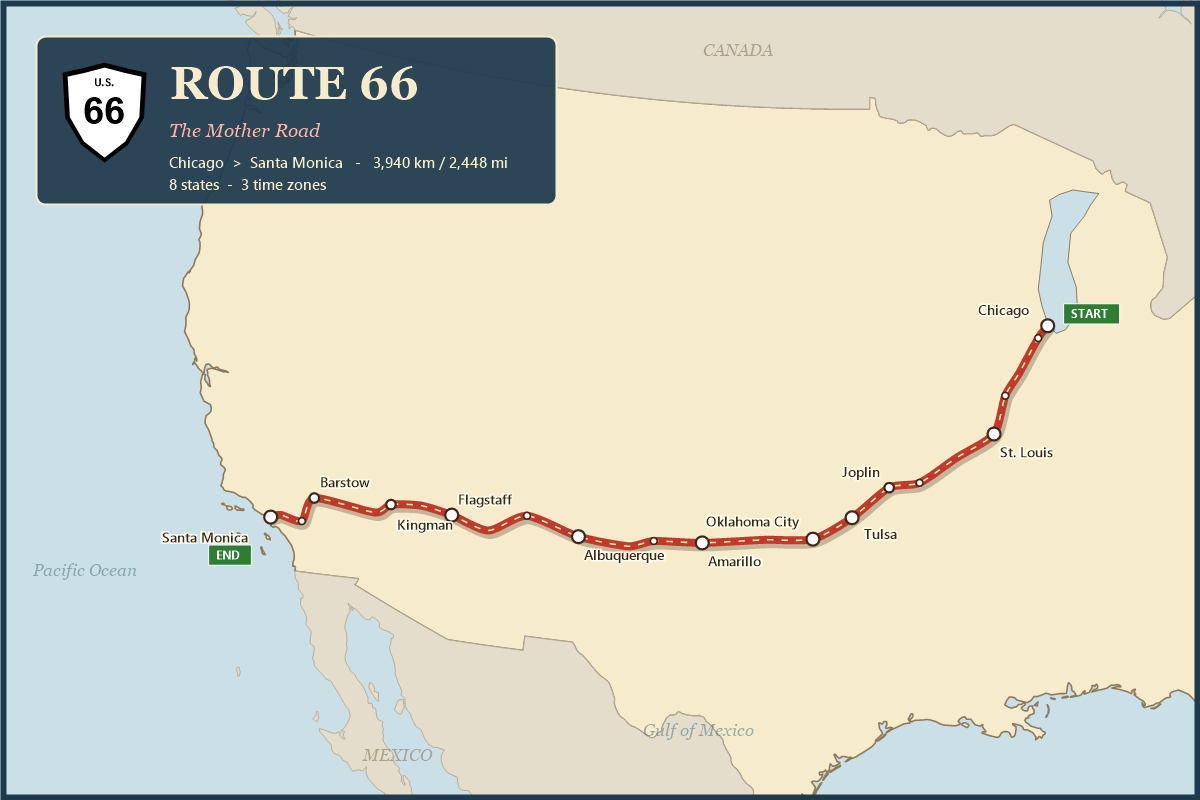
U.S. Route 66 is the most famous road in the United States: about 3,940 km (2,448 miles) that linked Chicago, in Illinois, with Santa Monica, in California, crossing eight states and three time zones. It was created in November 1926 and for decades it was the great road west; in 2026 it turns one hundred.
WHAT IT IS
It is known as “the Mother Road”, a name given to it by the writer John Steinbeck in “The Grapes of Wrath” (1939), the novel about the families who fled to California during the Great Depression and the Dust Bowl. It was also called “the Main Street of America”. After the Second World War it enjoyed its golden age, with motels, roadside diners and neon signs, until the interstate highways gradually replaced it. In 1985 it was officially removed from the federal highway system, but many stretches are preserved as “Historic Route 66” and today it is a cult road trip.
WHERE IT STARTS
In Chicago (Illinois). The “Begin Route 66” sign is on Adams Street, next to Michigan Avenue, near Grant Park and the Art Institute. It is the classic starting point for those who drive it from east to west.
WHERE IT ENDS
In Santa Monica (California), on the shore of the Pacific. The historic end is in Santa Monica, and the classic photo is taken by the “End of the Trail” sign, near the Santa Monica Pier.
CITIES AND STATES IT CROSSES (east to west)
- Illinois: Chicago, Joliet, Pontiac, Bloomington-Normal, Springfield.
- Missouri: St. Louis, Rolla, Springfield, Joplin.
- Kansas: only about 21 km (13 miles), with Galena and Baxter Springs.
- Oklahoma: Miami, Tulsa, Oklahoma City, Clinton, Elk City.
- Texas: Shamrock, McLean, Amarillo, Vega, Adrian.
- New Mexico: Tucumcari, Santa Rosa, Albuquerque, Gallup.
- Arizona: Holbrook, Winslow, Flagstaff, Williams, Seligman, Kingman, Oatman.
- California: Needles, Barstow, San Bernardino, Pasadena, Los Angeles and Santa Monica.
MUST-SEE STOPS
- Chicago: the starting sign and a breakfast at Lou Mitchell's, the traditional first stop.
- Springfield (Illinois): the Cozy Dog Drive In, which claims to have popularised the corn dog, the battered sausage on a stick.
- St. Louis (Missouri): the Gateway Arch, 192 metres tall, and the Chain of Rocks Bridge, a former Route 66 bridge over the Mississippi, now for pedestrians and cyclists. For something typical, try the frozen custard at Ted Drewes.
- Galena (Kansas): an old rusty tow truck that inspired the character Mater in the film Cars.
- Catoosa (Oklahoma): the Blue Whale, a giant sculpture from the 1970s beside a pond.
- Arcadia (Oklahoma): the round barn of 1898 and Pops, with its giant soda bottle.
- Amarillo (Texas): the Cadillac Ranch, ten cars buried nose-down in the ground in 1974 that visitors spray-paint, and the Big Texan restaurant, famous for its 72-ounce steak.
- Adrian (Texas): the Midpoint Café and the sign marking the midpoint of the route.
- Tucumcari (New Mexico): the Blue Swallow Motel (1939) and its neon signs.
- Albuquerque (New Mexico): Central Avenue, with historic motels and neon signs.
- Gallup (New Mexico): the El Rancho Hotel (1937), where film stars used to stay.
- Holbrook (Arizona): the Wigwam Motel, with rooms shaped like tepees, and Petrified Forest National Park, the only national park that preserves a stretch of Route 66.
- Winslow (Arizona): the “Standin' on the Corner” park, dedicated to the Eagles song “Take It Easy”.
- Flagstaff and Williams (Arizona): the historic centre of Flagstaff and, from Williams, a trip to the Grand Canyon, about 100 km away.
- Seligman and Oatman (Arizona): the barber shop of Angel Delgadillo, a driving force behind the preservation of the route, whose town partly inspired Radiator Springs; and the wild burros of Oatman, along a road with tight bends.
- Barstow and San Bernardino (California): the Route 66 museum in the Casa del Desierto station and the site of the first McDonald's.
- Santa Monica (California): the pier and the “End of the Trail” sign.
HOW LONG YOU NEED
Driving it end to end is about 40 hours behind the wheel, but the ideal is to give it about two weeks (10 to 14 days), with 300 to 400 km a day. It can be done in eight days, though in a rush.
WHEN TO GO
The best times are spring (April to June) and early autumn (September and October). In summer it is very hot in the Arizona and California deserts, above 40 °C, and in winter there can be snow and ice in Illinois, Missouri, New Mexico and the high parts of Arizona, such as Flagstaff. Many tourist businesses are seasonal.
HOW TO DO IT
Most people drive, and the usual choice is to rent a car in Chicago and return it in Los Angeles, although some companies charge a one-way fee. It is also very popular by motorbike. Much of the original road runs alongside, or beneath, the I-55, I-44, I-40, I-15 and I-10 interstates, and some stretches have been lost; follow the brown “Historic Route 66” signs and carry a dedicated guide or app, such as the “EZ66 Guide for Travelers”. In Arizona and the Mojave Desert there are stretches with few petrol stations and little mobile coverage: fill the tank and carry water.
WHERE TO SLEEP
Part of the charm of the trip is the historic motels, such as the Blue Swallow in Tucumcari, the Wigwam in Holbrook or the El Rancho Hotel in Gallup. In high season it is worth booking ahead, especially in small towns.
WHAT TO EAT
Breakfasts in roadside diners, steak in Texas, onion burgers in Oklahoma, green chile in New Mexico, Navajo tacos in Arizona and frozen custard in St. Louis. Diners usually accept cards, but in the smallest businesses it is worth carrying some cash.
TIPS
Before travelling, check the entry requirements for the United States: travellers from many countries, including Europeans, need an ESTA or a visa. Take out travel health insurance, because healthcare is very expensive. Find out whether you need an international driving permit. Traffic drives on the right and speeds are in miles per hour. You will cross three time zones (Central, Mountain and Pacific), and Arizona does not change its clocks in summer. Respect private property when photographing ruins and check the opening times and status of places before going, because many businesses change or close.
















 ES
 EN